What if the most ordinary piece of city infrastructure, the bus stop, became a mini nature-based solution that cools streets, supports pollinators, and manages stormwater? Across cities, experiments with plant-filled buses and vegetated bus-shelter roofs show how small, distributed “green patches” can stitch biodiversity and climate resilience into daily life, while opening new pathways for urban agriculture and edible-city thinking.
A moving reminder that cities can feel alive
Back in 2017, Taipei trialed a “Mobile Forest” bus: an interior dressed in plants and flowers, aiming to bring nature closer to commuters and nudge everyday conversations about greener urban living [1]. The general idea of a Mobile Forest experience with lush plant life throughout its interior, is a vivid example of how public transport can also be public climate culture [2]. Regardless, the initiative was not publicly supported and ran solely as a trial.
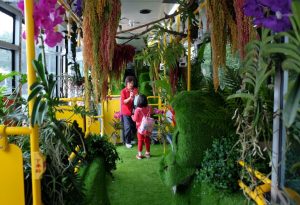
Credits: Atlas Obscuras, https://www.atlasobscura.com/articles/taipei-taiwan-forest-bus
Green bus shelters: biodiversity corridors and heat relief
More recently, green-roofed bus shelters have been highlighted as practical climate adaptation: living roofs can counter urban heat islands by shading and cooling through evapotranspiration rather than absorbing and re-emitting heat like conventional roofs [3]. They also help cities create small but meaningful habitat, as noted in the case of Boston where various plant choices attracted butterflies and bees, while Utrecht positioned living roofs to help form “bee lines” that keep pollinators fed.
Stormwater, air quality, and “quick wins” municipalities can scale
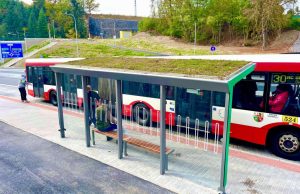
Credits: The Mayor, https://www.themayor.eu/en/a/view/pilsen-begins-installing-green-roofs-on-bus-stops-9293#google_vignette
More straightforward municipal benefits have also been identified sedum-based green roofs on bus stops can retain rainwater and reduce runoff, easing pressure on drainage during heavy rainfall events [4]. Utrecht, The Netherlands, boasts a network of more than 300 sedum-covered bus shelters, with 96 of them also being fitted with solar panels [5].
In Helsingborg, Sweden, converting 40+ shelters to sedum roofs was framed as a nature-based water buffer which also captures fine dust and stimulates biodiversity; the same case describes modular cassettes with high retention capacity, of more than 20 liters per sqm.², and low maintenance needs [6].
