Urban agriculture, and specific urban gardens can shape cities in many ways. They can support biodiversity, strengthen climate resilience, help reduce urban heat and create spaces that bring people and communities together [1] .
When it comes to urban gardens, does bigger mean better?
Not necessarily. We could say that for urban gardens its often the opposite.
Researchers from the FOODCITYBOOST project, Dr. Marta Sylla and Grzegorz Budzik from the Wrocław University of Environmental and Life Sciences, together with Catharine E. Schulp from Vrije Universiteit Amsterdam, analysed data from European cities to investigate how community gardens influence temperatures in their surrounding urban areas.
Their findings highlight an important point: the location of urban gardens can be just as important as their size.
In a recent study, it was reported that cities with smaller, strategically located gardens in the urban area showed the highest cooling efficiency. In this sense, a network of smaller green spaces embedded within the urban fabric can make a meaningful contribution to local climate regulation [2].
From research to real-life urban environments
The project’s Living Labs provide real-world environments where citizens, research organisations, local authorities, urban farmers and local authorities can exchange knowledge and test solutions in real-life conditions.
This approach was recently highlighted during the FOODCITYBOOST consortium meeting in Wrocław, Poland, where partners and stakeholders from across Europe came together to discuss the project’s progress, share initial findings and prepare for the next phase of activities.
Participants also had the opportunity to visit local urban agriculture initiatives in Wrocław, connecting discussions and research findings with the people and places directly involved in urban food production.
Read the full article: https://doi.org/10.1016/j.jenvman.2025.128275
Almere: a Living Lab for urban agriculture
Credits: Food Pioneers
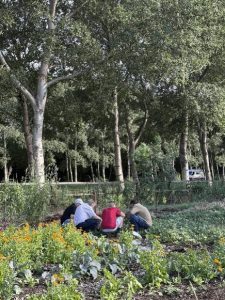
Among FOODCITYBOOST’s six Living Labs, Almere in the Netherlands offers an s fertile ground for experimentation in urban farming.
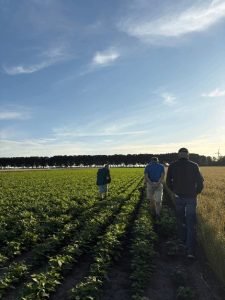
In Almere, the close connection between city and countryside creates a unique setting for urban agriculture. From pick-your-own gardens to urban farms, different forms of food production are integrated into the urban environment
As the local Living Lab coordinator, Food Pioneers connects stakeholders in Almere with FOODCITYBOOST researchers and the wider European consortium. During the consortium meeting, Food Pioneers presented the progress made so far in the Almere Living Lab and highlighted an important challenge for the next stage of the project: turning scientific findings into concrete and accessible recommendations that urban farmers and gardeners can use in practice [3].
Credits: Food Pioneers
The progress and experiences emerging from the Almere Living Lab are also showcased in a recent documentary released by FOODCITYBOOST, featuring insights from local innovators, growers and community actors involved in shaping the city’s urban agriculture landscape.
Watch the Practitioner Success Stories and discover more: https://www.youtube.com/watch?v=6WoDwmlwe4I&t=28s
Building the cities of tomorrow
As FOODCITYBOOST moves forward, evidence from its Living Labs is helping build a clearer picture of the multiple benefits urban agriculture can bring to European cities. The findings on the cooling potential of community gardens are one good example of why it matters.
All in all, a garden does not have to be large to make a difference. Where it is located, who can access it and how it connects with the surrounding neighbourhood can be just as important.
Urban agriculture (UA) is, once again, about much more than growing food. These spaces can bring people together, support biodiversity, encourage experimentation and help cities become more resilient to climate change.
That is what we see in Almere, and across the other FOODCITYBOOST Living Labs: urban agriculture becoming part of the city, connecting people, places and ideas.
References
[2] Budzik, G., Sylla, M., & Schulp, C. J. E. (2026). Cooling benefits of urban agriculture to inhabitants—Mapping cooling potential of allotments in European functional urban areas. Journal of Environmental Management, 397, 128275. https://doi.org/10.1016/j.jenvman.2025.128275
[3] https://www.foodpioneers.nl/post/food-pioneers-brengt-almeerse-praktijk-naar-foodcityboost-in-wroc%C5%82aw?utm_source=linkedin&utm_medium=social&utm_campaign=foodcityboost_wroclaw&utm_content=organic_post
